

Scared to run 20 minutes because you think your quads are going to evaporate? Convinced that every heartbeat above 130 BPM is eating your biceps?
Stop right there. That is fossilised bro-science, built on a sloppy reading of studies that are 40 years old.
Yes, there is a real biological conflict. Yes, your body hates doing two opposite things at once. But no, cardio does not kill your gains, as long as you understand the plumbing inside the cell.
Today we stop whining and open the hood. Welcome to the mTOR vs AMPK war.
Hickson’s shadow (1980)
It all starts with one legendary study: Hickson, R.C. (1980). Hickson took strong men and put them through hell. Heavy strength work stacked on top of an insane volume of running and cycling, 6 days a week.
After 7 to 8 weeks, strength plateaued, then dropped. Hypertrophy stopped dead. The bros drew their conclusion: “cardio eats muscle.”
Except the volume in that study was unsustainable, even for an Olympic athlete on steroids. What killed the gains was not molecular interference. It was systemic overtraining and glycogen depletion.
The idea stuck anyway. And it does have a kernel of truth: the interference effect exists. But it is molecular, not magic.
The science: the mTOR vs AMPK conflict
To understand why you stall, look at your signalling pathways. Your body runs on two main modes, and they mix like water and fire.
The builder: mTORC1
mTOR (Mammalian Target of Rapamycin) is the site foreman of anabolism. You lift heavy, you eat protein, you switch on mTORC1. Its job: protein synthesis, cell growth. Its fuel: amino acids (leucine first), insulin, growth factors like IGF-1, mechanical tension. Its message: we have resources, add another floor.
The crisis manager: AMPK
AMPK (Adenosine Monophosphate-activated Protein Kinase) is your fuel gauge. When you go hard on cardio, you burn ATP, the ATP/AMP ratio drops, and AMPK reads it as a crisis. Its job: mitochondrial biogenesis via PGC-1α, fat oxidation, efficiency. Its message: shortage alert, cut the spending, optimise the engine.
The crash: TSC2
This is where the war breaks out. Hypertrophy (mTOR) is an energy-hungry process, a luxury. Endurance (AMPK) is a survival process.
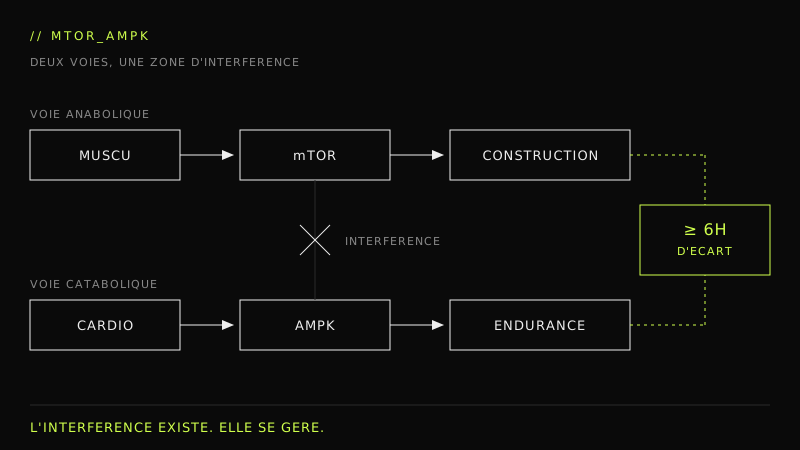
When AMPK fires hard, under heavy cardio or a calorie deficit, it phosphorylates and activates a protein called TSC2 (Tuberous Sclerosis Complex 2). And TSC2 is a direct inhibitor of mTOR.
You can’t ask your bricklayers to build a wall (muscle, mTOR) while you steal their bricks to burn in the fireplace because it’s cold (cardio, AMPK).
It all comes down to timing
This is where most coaches get it wrong. They think the block is permanent. It isn’t. AMPK activation is acute and transient.
You do a VO2max session in the morning. AMPK spikes. It fires PGC-1α to build new mitochondria, and it activates TSC2, which puts mTOR on hold.
But that pause doesn’t last three weeks. It lasts a few hours, in the range of 3 to 6 depending on the intensity and on what you eat. Once energy is restored, ATP back up and glycogen refilled, AMPK settles and the path opens again for mTOR.
The mistake is jamming your heavy squat session in while AMPK is still screaming in your cells, right after the cardio. You are sending two contradictory orders. Build, through mechanical tension. Shut it down, through chemistry. Your body no longer knows who to listen to.
The workaround protocol
You want to be a hybrid? A cyclist’s engine in a lifter’s body? Then you hack the signalling. Here is the protocol.
A. Time separation: the 6-hour rule
Don’t mix the signals. Ideal case, 24 hours between a heavy leg session and hard cardio. Minimum viable, 6 hours apart: cardio or endurance in the morning, enough time for AMPK to rise, do its work, then come back down; lifting in the evening, when the path is clear for mTOR.
Why that order? Because doing cardio on legs already wrecked by squats is a guaranteed injury and guaranteed nervous fatigue. Biochemically the reverse works too, but your body prefers the order above.
B. The nutrition hack: shut AMPK up
AMPK reads the ATP/AMP ratio and your glycogen. Fasted cardio, then nothing: AMPK stays high.
The fix is an insulin spike. Carbs after your cardio push insulin up, insulin activates Akt, and Akt inhibits TSC2. Translation: eating carbs after the session kills the energy-crisis alarm faster, and mTOR can get back to work sooner.
C. Picking your weapon: Z2 vs HIIT
Not all cardio is equal in front of the interference effect.
HIIT, sprints or CrossFit, is a massive metabolic stress. AMPK activation there is violent, and the conflict with lifting is at its maximum. Use it sparingly, far from your leg sessions.
Zone 2, base endurance, is a different animal. Low intensity, mechanical stress rather than “critical” metabolic stress, moderate AMPK activation. If you are well fed, with no total glycogen depletion, Zone 2 does not activate TSC2 hard enough to block hypertrophy.
The cheat code: Zone 2 on the bike, no eccentric impact, is the form of cardio that interferes least with hypertrophy. That’s why track riders carry those thighs.
Conclusion: be smarter than your own cells
Interference is real, but it is not a life sentence. It is an engineering constraint.
If you train natural: split your sessions (morning and evening, or alternate days), refuel straight after the effort to calm AMPK down, and favour Zone 2 volume over suicidal HIIT intensity when hypertrophy is the goal.
You can be strong and have an engine at the same time. You just have to stop training at random and start respecting your biology.
Cardio doesn’t kill gains. Stupid programming does.