

DST (Dopamine Saturation Threshold): the exact point where, on a monotone effort (Zone 1-2), your dopamine drops under the line that keeps your brain plugged in. Your glycogen stores are full. Your legs are fresh. The nervous system is what walks out. House concept (see the glossary), not a clinical entity. Useful anyway.
Your brain quits before your legs do
Stop whining. If you can wreck yourself on a sprint but want to throw yourself under a truck after 45 minutes on the trainer at 130 watts, you are not “mentally weak”. You are in DST failure.
Traditional endurance training runs on a soporific straight line. For a neurotypical brain, call him Dave, that is meditative. For you, it is sensory torture.
Your brain runs like a solid state drive with an obscene write speed. It needs a massive data stream: intensity, complexity, danger. Zone 2? You are transferring a 1 KB file to a NASA server. The system idles, overheats, and starts throwing errors. Intrusive thoughts, anxiety, compulsive playlist skipping.
The mechanics of the crash: noradrenaline versus dopamine
The Rusty Scalpel Law applies to your internal chemistry too.
On a hard effort (threshold, VO2max work), your body makes noradrenaline, survival, and dopamine, reward. The cocktail is powerful. Your brain locks on. You are a machine.
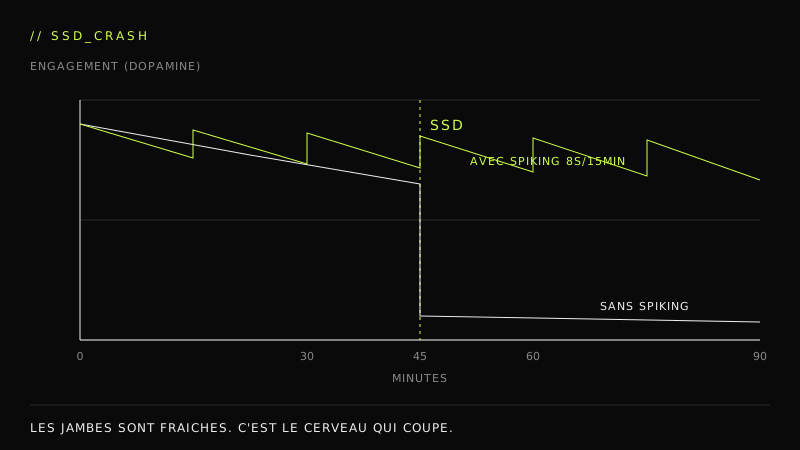
On a monotone Zone 2 effort, none of that. No danger, so no noradrenaline. No immediate win, so no dopamine. The desert. And at some point, 30 minutes, 45, depends on the day, your dopamine drops under the critical line. That is the break point. Your brain starts reading boredom as real physical pain.
Result: your RPE, your perceived effort, climbs to 8/10 while your legs sit at 2/10. You bail on the session. You feel like garbage.
Neurotypical versus you
| Variable | Neurotypical athlete | ”DST profile” athlete (ADHD / high-IQ) |
|---|---|---|
| Reaction to Zone 2 | Relaxation, meditation | Stress, agitation, “mental noise” |
| Main limiter | Glycogen / muscular fatigue | Dopamine drop (DST) |
| Power curve | Steady until empty | Erratic, collapses before the fatigue |
| Stimulation need | Low (routine reassures) | High (routine destroys) |
| Optimal strategy | Constant volume | Micro-variation and gamification |
The workaround protocol
You do not cure DST. You learn to push it back. If your coach tells you to “empty your mind”, change coach. You have to do the opposite: saturate the bandwidth.
Three techniques from the Cornerman Protocol.
1. Cadence micro-variation
Never sit at the same cadence for more than 5 minutes. 5 min at 85 RPM for torque, 2 min at 105 RPM for leg speed, repeat. The switch forces your brain to recalibrate and keeps cortical arousal up.
2. Controlled intrusion: spiking
Every 15 minutes, drop an 8-second sprint at 150% of FTP. This is not for the muscle. It is a catecholamine shot: you wake the nervous system with a dose of danger, then you come back down. You just bought yourself 15 minutes of mental quiet.
3. Saturate your cognitive load
If the physical effort is low, the cognitive load has to be high. Dense technical podcasts at 2x, mental arithmetic, whatever works. Leave no free RAM for boredom to move into.
Conclusion
DST does not get you out of base work. It is a mechanical constraint, and a constraint is something you route around. Find your time limit. 30 min? 45 min? That is your current DST. Nobody is asking you to enjoy it. We are asking you to raise that number, minute by minute, with science instead of “motivation”.
Cornerman, out.