
Everyone loves watching the head unit read 300 watts. Round number, satisfying, manly. On the flat it makes you feel like a freight train. On Zwift it gets you noticed on Tempus Fugit.
But real cycling, the kind that happens outdoors when the road tilts up, could not care less about your ego.
Past 6% gradient, raw power becomes a secondary stat. You can push 300 watts, but if you carry the body density of a dead donkey, you are not powerful. You are an anvil with a lawnmower engine.
Welcome to the clinical reality of gravity.
The big-number illusion
The problem with absolute power, raw watts, is that it hides inefficiency. On the flat your enemy is air. Heavy means inertia; once you are rolling, it rolls for you. Which is another way of saying you can stash a decent amount of adipose tissue behind a big shove on the pedals.
That is where the scam operates. You come home from a flat ride averaging 35 km/h telling yourself I am a machine.
No. You are heavy, you are as aerodynamic as a brick, and you compensate with brute force. Pure waste. On the flat it gets away with it. That is exactly the trap.
The physics: Newton does not lie
The moment the road rears up, the rules change. You go slower, aerodynamics drops to second place, and a new judge walks in: gravity.
Isaac Newton is impartial and merciless. The equation fits on one line: lifting mass costs energy. The bigger the mass, the more every metre of ascent costs you. Every kilo of useless fat is a stowaway strapped to your rack. It does not pedal. You haul it anyway.
Hence W/kg. Your power-to-weight ratio. In the mountains it is the only metric that tells the truth. The rest is literature to make you feel better.
The Anvil versus the Pocket Rocket
A concrete example, to humble whoever needs humbling. Take a classic climb, say the Col de l’Espigoulier.
The “big rouleur” (the Anvil):
- Weight: 85 kg.
- Threshold power: 250 W. Solid, on paper.
- Ratio: 2.94 W/kg.
The “Pocket Rocket” athlete (real profile, anonymised):
- Weight: 55 kg (at 1.48 m).
- Threshold power: 180 W. Sounds weak, doesn’t it?
- Ratio: 3.27 W/kg.
On paper the Anvil puts out 70 watts more. He feels strong. He is wrong. On the gradient, Pocket Rocket drops him.
3.27 W/kg against 2.94 is not a contest. The Anvil suffocates hauling his 85 kg plus 8 kg of bike while the other one dances on the pedals.
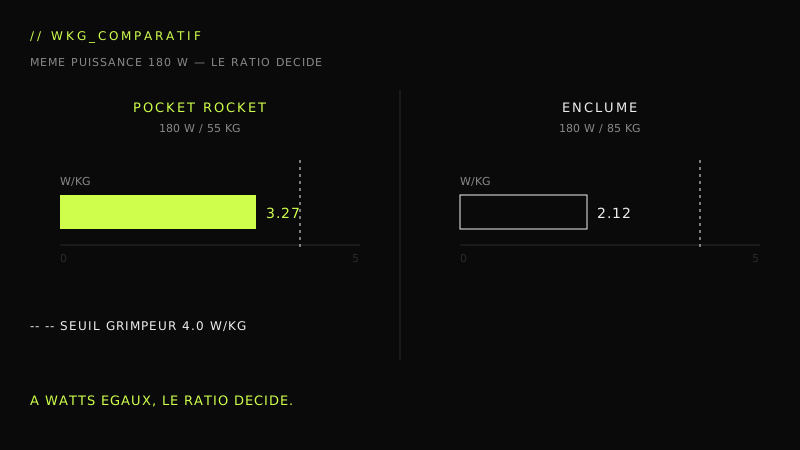
The reason is simple. She is not fighting her own structure. Her watts move her forward instead of paying off her gravitational existence.
The magic ratio: the most accessible doping there is
Take the Cornerman logic all the way.
Adding 20 watts to your FTP takes months of structural work: sweet spot, VO2, suffering. It is long, it is hard, and nothing guarantees the result.
Losing useless fat? That is calorie arithmetic.
Back to Pocket Rocket. Her structural target is 49 kg (race weight set against her height, via a strict 1450 kcal/day plan, power held). Same 180 W, run the numbers again:
180 W / 49 kg = 3.67 W/kg.
3.27 becomes 3.67. To rip out the same gain without touching weight, she would have had to push FTP to 202 watts. Good luck with that.
Those 6 kg of ballast gone are mechanical doping, perfectly legal. Free. It even costs less at the supermarket. And it works immediately.
Conclusion
Stop massaging your own ego with your 5-second peak power or your raw FTP if you do not know your body weight to the decimal.
Climbing fast gives you two levers: push harder (hard, slow) or weigh less (discipline, kitchen). The smart rider plays both. The idiot burns his money on carbon wheels to save 200 grams while dragging 5 kg too many around his waist.
Stop staring at your head unit. Look at your plate.
THE CORNER DOES NOT CUT YOUR HEALTH. The Scalpel cuts bullshit, not your health. The 49 kg and the 1450 kcal/day quoted here document one personal approach, supervised and calculated to the gram, not a prescription. Below your baseline needs, or at the first sign of doubt, see a sports physician.