

You ride 10 hours a week. Your quads are cut. You climb decently. And you think your legs are strong.
Wrong.
Walk into a gym. Load a bar to 1.5x your bodyweight. Drop into a full squat. If you come back up for 5 reps, congratulations: you sit in the 5% of cyclists who aren’t shrimps dressed as endurance athletes.
Didn’t come back up? Then you have muscular endurance. Not strength. And that is exactly why you cap out on sprints, on accelerations, on the kick halfway up a climb. Your FTP is fine. Your explosive power is pathetic.
Joe Friel says it flat out in Chapter 12 of The Cyclist’s Training Bible: cyclists who dodge heavy lifting are deliberately under-built. They choose to be weak. Out of fear, out of ignorance, or out of that ridiculous superstition that “lifting heavy = adding muscle = going slower uphill”.
We take that apart piece by piece.
Watts = Force × Velocity
The power you read on your Garmin is an equation:
Power (W) = Force (N) × Angular velocity (rad/s)
Plain version: how hard you push the pedal, multiplied by how fast you turn your legs. Two levers. Spin faster, or push harder.
Most cyclists work the first one only. Cadence drills, sweet spot, endless Z2. They optimise one side of the equation and leave the other fallow.
Except the maximum force you can put through a pedal is capped by your raw muscular strength. If your squat 1RM is laughable, say 60 kg for a 70 kg guy, your ability to produce explosive force on the bike is capped too. Not because your endurance is short. Not because your cardio is weak. Because your motor units don’t know how to recruit enough fibres in a single contraction.
The link is direct: maximal squat strength and sprint power. Deadlift strength and uphill acceleration. Rate of force development (RFD) and how fast you get back up to speed out of a corner.
Translation: without heavy squats, you will never be explosive. Never.
Pedalling is not strength training
Here the average cyclist tells me: “But I push hard on the pedals! Especially climbing! That counts, right?”
No.
1. The load is always submaximal
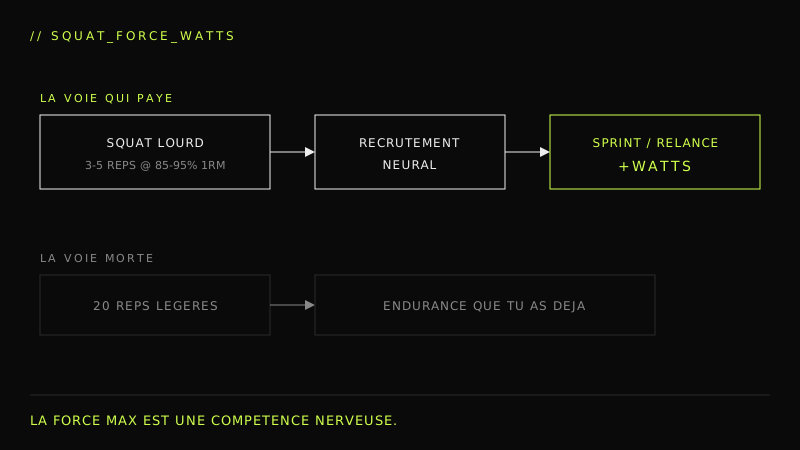
Even on a 10% ramp at 200W, the force going through each pedal sits around 20 to 30% of your maximal voluntary force. That’s an endurance load, not a strength load. To build neural strength, the kind that counts, you work at 85-95% of your 1RM. Sets of 3-5 reps with a bar loaded to the limit. Not sweet spot intervals at 88% of FTP.
2. The motor pattern never changes
Cycling is 90 rpm, 60 minutes, 5 days a week. Same movement, same angle, same recruitment, forever. You polish one pattern, you don’t build new neuromuscular capacity. The pianist who plays the same piece for ten years gets frightening at that piece. He doesn’t become a better pianist.
3. Type IIx fibres never get called
Type I endurance fibres develop on low-intensity volume. Type IIa mixed fibres answer to threshold and sweet spot. But Type IIx, explosive force and raw power, only wake up when you ask for something close to maximal.
Pedalling, even hard, doesn’t do it. You need a heavy, short, neurally intense stimulus. Squat, deadlift, press. That’s the list.
The squat protocol: 3-5 reps, heavy, neural
The point of lifting for a cyclist isn’t hypertrophy, meaning adding muscle. It’s neural strength: learning to recruit more motor units, raising firing frequency, improving rate of force development. What follows is the protocol Friel refined over decades with elite athletes.
Phase 1: Anatomical Adaptation, 4-6 weeks
You prepare tendons, ligaments, connective tissue, and you learn the movements. Squat, deadlift, leg press, step-ups, core work (planks, anti-rotation). Light: 40-60% of 1RM, long sets of 15-20 reps, 2-3 sets, 2 to 3 times a week. Controlled tempo, total focus on form.
It’s boring, granted. It’s also mandatory. Skip it to load straight away and you get hurt: tendons don’t adapt as fast as muscle.
Phase 2: Maximum Strength, 8-12 weeks
The core of the reactor. This is where you build maximal strength, recruit Type IIx, raise RFD.
- Exercises: squat, deadlift, leg press. The three main ones, nothing else.
- Loads: 85-95% of 1RM
- Reps: 3-5 reps × 3-5 sets
- Rest: 3-5 minutes between sets. Yes, that’s long. It’s your nervous system recovering, not your lungs.
- Frequency: 2x a week (Tuesday + Friday, for instance)
- Tempo: controlled on the way down, explosive on the way up
You don’t put on mass: total volume is far too low for that. You teach your nervous system to recruit more fibres at once. Wiring, not construction.
Rønnestad showed it in cyclists who added two heavy squat sessions a week for 12 weeks: squat 1RM jumping by about a third, a few percent gained on sprint power and pedalling economy, and a scale that didn’t move a gram.
More strength, more power, same weight. Pure neural adaptation.
Phase 3: Maintenance, all year
Once that strength is built, you don’t let it go. One session a week does the job: 3-5 reps at 80-90% of 1RM, 3 sets, slotted after an easy Z2 ride or an active recovery day. Thirty minutes.
Plenty of cyclists make the mistake of dropping everything in season. After 8-12 weeks out of the gym their strength collapses, and with it the kick, the sprint, the acceleration.
One session. Per week. Not negotiable.
When to lift, when to ride
Here is where most cyclists blow it: they squat heavy on the same day as a VO2max interval session. Or 48h before a race.
No. Stop. You’re being stupid.
Integration rules
Strength days are quality days. No heavy squats after an interval session. No heavy squats the day before one. The gym is a key session. Treat it like one.
Where it goes in the week (example, 10h/week):
| Day | AM | PM |
|---|---|---|
| Monday | OFF or easy Z2 | Heavy squat (MS) |
| Tuesday | Sweet spot / tempo | - |
| Wednesday | Long Z2 ride | - |
| Thursday | OFF or easy Z2 | Heavy squat (MS) |
| Friday | Threshold / VO2 | - |
| Saturday | Z2 or group ride | - |
| Sunday | Long Z2 ride | - |
Tapering into a goal event: last full MS session 3-4 weeks out. At 2 weeks, drop to 70% of 1RM, 3 reps × 2 sets, light maintenance. Final week? Nothing. Complete rest from the gym.
Soreness (DOMS). The first weeks will hurt. That’s normal, and it fades after 4-6 sessions. If you quit because “your legs feel heavy”, the problem isn’t in your legs.
Right timing means starting off-season (November to January), running a real 4-6 week AA phase to let the tissue adapt, and never introducing MS in the middle of the racing season.
The ridiculous fear of getting big
The elephant in the room: cyclists afraid of looking like bodybuilders.
Superstition.
Adding meaningful muscle mass takes high volume (8-12 reps, 4-5 sets, several exercises), high frequency (4-6x a week), a calorie surplus of +300-500 kcal a day and a lot of time under tension. Friel’s protocol (3-5 reps, 2x a week, long rests) ticks none of those boxes. You aren’t building muscle. You’re building neural strength.
The studies converge: cyclists running MS for 12 weeks gain half a kilo of lean mass at worst. Negligible. And that mass is functional: more mitochondria, more capillaries, better recruitment.
If you refuse to squat because you’re scared of 500 g, you’re a clown.
Strong in endurance, weak in pure force
Friel draws a brutal line in his chapter. On one side, endurance strength: holding submaximal force for a long time, in sweet spot, in tempo, in Z2. On the other, maximal strength: producing close to 100% in a single contraction, a 1RM squat, a standing sprint, a violent kick.
Cyclists optimise the first. They ignore the second.
Result: you hold 250W for 45 minutes and you can’t put out 1200W for 5 seconds. Your peak power is laughable, your RFD is slow, your acceleration is soft.
You’re a diesel. Not a V8.
And you pay for it everywhere: coming out of corners in a crit, in the final sprint, in sharp uphill attacks, in the first 30 seconds of a time trial.
Schmidtbleicher laid it down back in 1992: maximal strength is the foundation of every other strength quality, explosive, force-velocity, endurance strength. Weak base, everything above it capped.
No, your on-bike force intervals don’t cut it
“But I do MTI! That’s strength, right?”
No. That’s sport-specific endurance strength.
MTI (50-60 rpm, 80-85% FTP, on a climb or against heavy resistance) have their uses, no argument here: they recruit Type IIa, improve force-endurance in the riding position, and prepare you for long climbs like Alpe d’Huez.
But they don’t build neural strength. The load stays submaximal (~60-70% of max force), time under tension is too long (3-5 minutes), and the motor pattern is identical to riding: no cross-pattern transfer.
MTI are a supplement. Squats are the foundation. In practice: MTI in the Build phase (specific), squats in Base and maintenance all year.
THE CORNERMAN’S PRESCRIPTION
What you do this week:
1. Test your squat
- Full warm-up (mobility, 5 min rower, bodyweight squats)
- Load up progressively: 40% → 60% → 80% of bodyweight
- Find the load you can move for 5 clean reps (full descent, thighs to parallel minimum)
- If you can’t squat your own bodyweight for 5 reps: you’re weak. Full stop.
2. Block two strength slots a week
- Slot 1: Monday or Thursday evening (after easy Z2 or an OFF day)
- Slot 2: Wednesday or Friday evening (same)
- Duration: 30-45 minutes (warm-up + 3 exercises + cool-down)
- Those slots are non-negotiable for the next 12 weeks.
3. Start with 4 weeks of Anatomical Adaptation
AA programme (2x a week):
- Squat: 3 sets × 15-20 reps @ 50% of estimated 1RM
- Deadlift or leg press: 3 sets × 15-20 reps @ 50% 1RM
- Step-ups (loaded): 2 sets × 12 reps per leg
- Plank + anti-rotation: 3 sets × 30-60 sec
Tempo: 2 seconds down, 1 second up. Total focus on form.
After 4 weeks you move to Maximum Strength: 3-5 reps, 85-95% 1RM, 3-5 min rest.
Bottom line:
If you want to be fast on a bike, get strong before you get durable. Maximal strength is the foundation. Endurance is the house you build on top of it.
Cyclists who ignore the gym are condemned to plateau. FTP that stalls. Pathetic sprint. Soft acceleration.
Friel hands you the protocol. I’m telling you to run it.
Now go squat.
THE CORNER DOESN’T CUT YOUR HEALTH. The Scalpel cuts bullshit, not your health. Loads at 85-95% 1RM and a +300-500 kcal surplus document a personal approach, not a prescription. Below your baseline needs, or at the first hint of doubt, see a sports physician.