
You finish your indoor sessions with a puddle of sweat under the bike and a headache worthy of a hangover? Congratulations. You are melting.
You think hydration is for the fragile, or for five-hour rides in a heatwave. Wrong. It is the most underrated and worst-managed performance lever you own. Whether you never touch your bottle or you sink 2 litres an hour, you are probably sabotaging your FTP.
The numbers are brutal. Lose only 2 % of your body mass in water and your endurance collapses (up to -20 % on time held at high intensity), while raw power drops 3 to 5 %. But drinking like a drain is not the answer either. If you piss every 20 minutes, you are not hydrating. You are rinsing.
Here is the clinical protocol to turn your cooling system into a weapon.
One hour without drinking and you are already melting
Mistake number one of the lazy Sniper: “It’s only an hour, maybe 90 minutes, I’ll drink when I get back.”
Except dehydration starts on the first minute. Even at low intensity (Z2), you lose water through breathing and thermoregulation. The second you drop 1 % of your body weight in water, your core temperature rises and your stroke volume, the amount of blood your heart pushes per beat, falls. Your heart compensates by beating faster for the same power, and you finish with pointless nervous fatigue that wrecks tomorrow’s recovery.
Even for one hour, the bottle is mandatory.
The camel strategy does not work
You tell yourself: “I’ll sink a litre right before I leave, then I’m sorted.”
Your body is not a passive tank. Throw down a litre of plain water in one go and your kidneys read it as a drop in blood osmolarity. Result: they open the gates, and you piss 80 % of that water out within 30 minutes. What’s left is 1 kg of fluid sloshing in your stomach, still not in your blood. Dead weight.
The Cornerman’s call: hydrate steadily in small doses (200 ml) over the 2 hours before the ride. No last-minute water shock.
How you dehydrate yourself by drinking
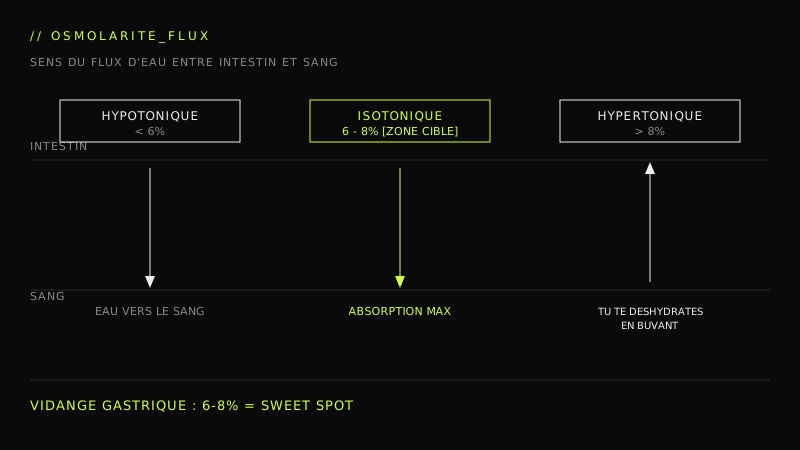
This is where 90 % of cyclists shoot themselves in the foot. Your gut runs on osmosis. Swallow a drink too concentrated in sugar (>8 %), or a neat gel without enough water, and you create a hypertonic environment.
Here is the damage: to dilute that syrup and absorb it, your body pulls water out of your blood plasma into your gut. You dehydrate yourself by drinking. Your blood turns to molasses, blood volume drops, and your legs go out.
[ ! ] The gel trap: taking a 30 g carbohydrate gel without 300 ml of plain water sabotages your blood volume on the spot. To handle your sugars without ending up folded over a ditch, read the guide: Build your own gels.
The weigh-in test: calculate your sweat rate
To know how much to drink, stop guessing. Use the data. This is the sweat rate protocol.
The protocol:
- Weigh yourself naked right before the session (example: 84.0 kg).
- Ride one hour at target intensity (sweet spot or Z2). Drink normally during that hour and note how much.
- Weigh yourself naked again after towelling off (example: 83.5 kg).
The maths:
(Weight before - Weight after) + Fluid drunk = Total loss
(84.0 - 83.5) + 0.75 = 1.25 L/h
You lose 1.25 L per hour and only drink 750 ml? You are in deficit. Does that mean you should siphon 1.25 L an hour to compensate? No. Not because it would be useless, but because your stomach won’t take it.
The real ceiling: what your stomach accepts
You read “600 to 800 ml per hour” everywhere, repeated as if it were a universal constant. It is an average. An average build, at an average intensity, with an average bottle.
And the bottleneck is not your gut: the small intestine absorbs faster than your stomach empties, especially when glucose-sodium cotransport drags water along with it. The real bottleneck is gastric emptying. And it moves with three things.
Your build
A 95 kg guy and a 52 kg woman do not have the same stomach. Count roughly 11 ml per kilo per hour:
| Rider weight | Realistic ceiling |
|---|---|
| 55 kg | 0.60 L/h |
| 72 kg | 0.79 L/h |
| 90 kg | 0.99 L/h |
| 105 kg | 1.16 L/h |
Your intensity
Past roughly 80 % of your FTP, your blood goes to the muscles. Splanchnic blood flow collapses and gastric emptying goes with it: up to 10 % less capacity when you are buried. It is mechanical. You cannot sprint and digest at the same time.
That is why you drink on the descents and the false flats, not on the 12 % wall.
The concentration in your bottle
Syrup sits. The more carbohydrate you load into your drink, the longer it lingers in the stomach before crossing. Past 8 % w/v you are not drinking any more, you are filling a pouch. That is the whole osmolarity story, laid out here: I turned my gut into a pressure washer.
It is 38 °C, you sweat 1.4 L/h, so you drink 1.4 L/h? No. Heat raises your LOSSES, never your capacity to absorb. Your stomach empties at the same rate, and hyperthermia tends to slow it down if anything. In serious heat, the deficit is not something to avoid, it is data to absorb: over 4 hours you finish at -2 L whatever you do. You manage it BEFORE (pre-hydration), DURING (cooling, pacing) and AFTER. Not at the bottle.
One piece of good news to close: that ceiling trains. Long-distance triathletes take 1.2 and even 1.5 L/h because they spent months teaching their stomach to work under load. You build it in training. Never on race day.
Sodium: the cement that keeps water in your blood
If you piss buckets, your water is too pure. The body hates diluted blood (hyponatraemia): drink plain water with no salts and your kidneys get the order to dump it immediately.
Target 600 mg to 1000 mg of sodium per litre. The mechanism: sodium drives the SGLT1 pumps in your gut, which pulls water towards your blood. Without salt, the water stays in the pipe and ends up in your bladder.
Indoor vs outdoor: the thermal war
Indoors: the furnace
No relative wind, so sweat does not evaporate. It runs. Core temperature climbs, blood thickens, heart rate runs away (cardiac drift). Ventilate hard and salt your bottles.
Outdoors: invisible evaporation
Wind makes you feel dry. That is the trap: you lose as much water as you do indoors. Drink to the clock, one mouthful every 10-12 minutes, thirst or no thirst.
Training dry, the false good idea
If you think skipping the bottle for an hour will make you harder or produce natural EPO, you are confusing an athlete’s training with a hostage’s.
Training dehydrated cancels the benefits of heat acclimation (Cheung & McLellan, 1998). No plasma, no nutrient transport, so no supercompensation. No EPO at the end of it. Just an engine that has forgotten how to cool itself.
And that engine heats up fast. At 84 kg you are a massive thermal machine: for 200 W at the pedals you generate roughly 600 to 800 W of heat. If you do not drink, your brain cuts the throttle (the central governor) as soon as core temperature approaches 39.5 °C, to keep your neurons from cooking.
The Cornerman’s shortcut (counting calories): by a mathematical accident tied to human efficiency (~25 %), 1 kJ on your head unit ≈ 1 kcal burned. Hold 200 W for an hour and that is 720 kJ of work, so around 690 kcal. That is how much energy your body has to dump, mostly through sweat.
[ KO ] The Cornerman verdict
Stop copying the pros if you do not have their history. If you piss crystal clear during your session, you are washing your minerals out. What we want is straw yellow.
Your orders:
- Run the weigh-in test on your next session.
- One bottle per session, even a 60-minute one.
- Add electrolytes (600 mg of sodium minimum).
- Stop drinking 1.2 L if you spend the ride pissing. Drop to 700 ml and raise the salt.
- Drink in small mouthfuls so you do not flood the stomach.
So, Sniper, do we keep playing public fountain, or do we start hydrating the muscles for real?
THE CORNER DOES NOT CUT YOUR HEALTH. The Scalpel cuts bullshit, not your health. The 2 % of body mass, the sodium doses and the 690 kcal document one personal approach, not a prescription. Below your baseline needs, or at the first sign of doubt (abnormal cramping, dizziness, hyponatraemia), see a sports physician.