
You know that brick in your stomach fifteen minutes after a gel? The moment your legs turn to lead, right after you shoved 30 g of sugar down your throat? Welcome to hypertonicity.
Taking an energy gel is an act of internal chemistry. Get the dilution wrong and instead of gaining energy, you steal water from your own blood.
Osmolarity, the blood vacuum pump
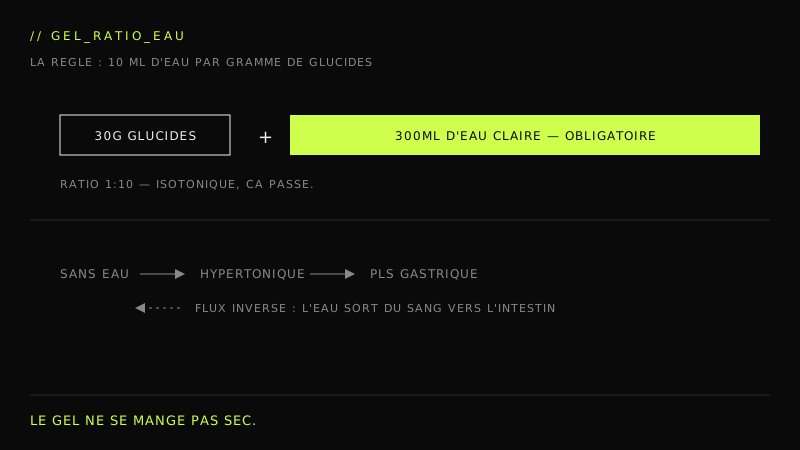
Your gut is a strict customs officer. Nutrients only get through if the concentration sits close to your blood, around 300 mOsm/L.
A pure sugar gel is hypertonic. Massive concentration. When it lands in your gut, your body has no choice: it has to dilute it right now, and to do that it pulls water straight out of your blood plasma. Blood volume drops, blood thickens, stomach bloats. Flash dehydration, on the house.
The Golden Rule: a 30 g carbohydrate gel ALWAYS goes down with 250 to 350 ml of plain water. Wash it down with an already-sugared sports drink and you make it worse.
Maltodextrin and fructose, the dual transporter
Why do the expensive gels mix several sugars? Because your gut has a limited number of doors. Glucose (or maltodextrin) goes through SGLT1, capped at ~60 g/h. Fructose takes another door, GLUT5, good for ~30 g/h on top.
Mix the two at a 1:0.8 ratio and you can push 90, even 120 g of carbohydrate per hour without saturating the transporters. Glucose only? The surplus sits there, ferments, and ends in a gut disaster.
Home recipe: poor man’s Maurten
This is the recipe Jon Albon used to win the CCC (the 100 km UTMB race). Neutral, effective, ten times cheaper than shop-bought.
Ingredients for 250 ml (about 6 gels):
- 100 g maltodextrin (stable energy)
- 80 g fructose (the 1:0.8 ratio, exactly)
- 120 ml water
- 1.5 g pectin (the secret agent)
- 1 g salt (sodium helps absorption)
- Optional: a splash of lemon juice for acidity.
Pectin is the detail that changes everything. First for handling: it turns sticky syrup into a semi-solid gel, so it does not run everywhere and you dose it by squeezing. Then for your stomach: it acts as a pseudo-hydrogel that helps encapsulate the sugars and softens the osmotic hit. Not the full Maurten shield, fine. But 80 % of the job for 2 % of the price.
Instructions:
- Heat the water in a saucepan.
- Add maltodextrin, fructose, pectin and salt. Stir for 1 min.
- Take it off the heat and let it cool.
- Pour it into a soft flask before it sets too hard.
Maurten, Beta Fuel and the rest: worth the money?
Let’s be honest: Maurten sells sugar at the price of gold. But there is a real piece of physiology behind the marketing.
Their hydrogel is a mix of pectin and sodium alginate. On contact with stomach acid it forms a gel structure that hides the sugar. The body never registers the osmolarity, the package crosses without pumping blood water, then releases the sugar in the gut. Clever.
Some gels (Maurten 160, Beta Fuel) also add potassium for muscle function, sometimes bicarbonate to buffer acidity.
My verdict? If your stomach is made of concrete, my home recipe is enough. If you cramp up the second you go past 90 g/h, spending money on Maurten makes sense for your A races. The rest of the time, it is waste.
[ KO ] The Cornerman verdict
A gel is a precision tool, not a sweet. Never without plain water. The 1:0.8 ratio is law. And pectin is your friend unless you want your gut running a spin cycle.
So, Sniper, do we keep playing Russian roulette with our stomach, or do we start feeding the engine properly?
THE CORNER DOES NOT CUT YOUR HEALTH. The Scalpel cuts bullshit, not your health. The 90-120 g of carbohydrate per hour document one personal approach, tested in training, not a prescription. Below your baseline needs, or at the first sign of doubt (digestive trouble, diabetes), see a sports physician.