
You’re planning a VO2max session. 5 by 3 minutes. At what power?
You look at your FTP, take 115 %, and set off. Session one: you blow up on the third rep. Next time you back it off. Now it’s too easy and you finish fresh.
You’re guessing. Feeling your way. While physiology has been holding out an equation since 1965.
First, how you find your two numbers
In the previous article we laid out the model: your CP (the sustainable wall) and your W’ (the finite reserve above it, in joules). Now you measure them. It’s simpler than it sounds, and it all comes down to one straight line.
You do two maximal efforts of different durations. For each one, you work out total work: average power times duration in seconds. Plot those two points on a work-versus-time graph. You get a straight line.
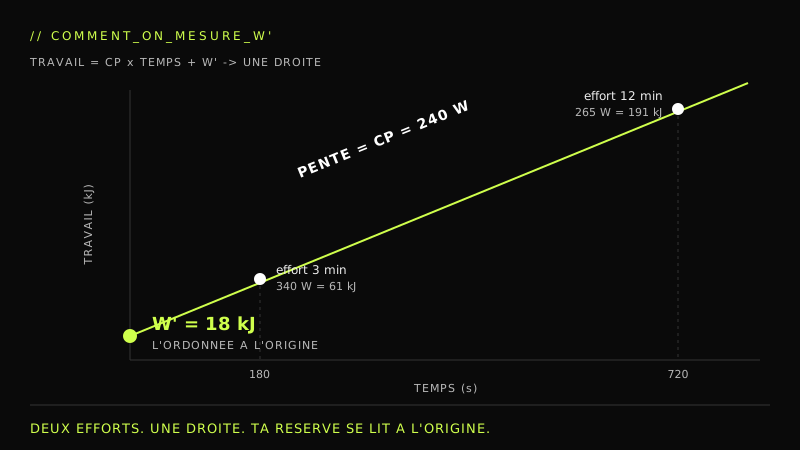
The equation of that line is Work = CP × time + W’. A y = ax + b in disguise. The slope gives you CP. The intercept gives you W’, literally the reserve you would produce in zero time.
Concrete example. An athlete does two efforts, fresh, 24 hours apart:
- 3 minutes at 340 W. Work = 340 × 180 = 61,200 joules.
- 12 minutes at 265 W. Work = 265 × 720 = 190,800 joules.
The slope between those two points: (190,800 − 61,200) / (720 − 180) = 129,600 / 540 = 240 W. That’s his CP.
The intercept: 61,200 − (240 × 180) = 18,000 joules. That’s his W’.
Check it against the other point if you don’t trust it: 190,800 − (240 × 720) = 18,000. Consistent. This athlete runs on a CP of 240 W and a reserve of 18 kJ.
The protocol, and its traps
Two or three efforts, all-out, all fresh. Three points beat two: you get a correlation coefficient that tells you whether your model holds. Close to 1, it’s clean. Low, one of your efforts was badly executed.
The durations have to land in the severe domain, roughly between 2 and 15 minutes.
Too short, under 2 minutes, your W’ dominates and inflates CP. Too long, past 20 minutes, you drop below your CP and underestimate it. The protocol you pick changes the result (Muniz-Pumares et al., 2019), so keep the same durations from one test to the next and compare what’s comparable.
One thing worth knowing: intervals.icu and Golden Cheetah run this calculation on their own from your power curve. Your job isn’t the arithmetic. It’s feeding that curve with real maximal efforts, well paced, over the right durations. The software handles the rest.
Now, the real payoff
Once you know CP and W’, you hold the equation that changes everything:
time to exhaustion = W’ / (power − CP)
Back to our athlete, CP 240 W, W’ 18,000 J.
- At 300 W: 18,000 / (300 − 240) = 18,000 / 60 = 300 seconds, 5 minutes before he’s empty.
- At 280 W: 18,000 / 40 = 450 seconds, 7:30.
- At 330 W: 18,000 / 90 = 200 seconds, 3:20.
No more guessing. You read off how long you last at any intensity above your wall.
How you calibrate the session
Come back to your 5 by 3 minutes at VO2max.
You want time spent high without killing the athlete on the third rep. So you pick a power whose time to exhaustion is roughly 1.5 to 2 times the length of your rep. Here, 300 W holds for 5 minutes on its own. For 3-minute blocks that’s ideal: he finishes each rep dented but not emptied, and he can string several together.
Send him out at 330 W and his rep lasts exactly his time limit. He blows up on the first one. That’s the classic mistake, and now you know why it happens.
That leaves recovery. It recharges the battery. And this is where W’ balance comes in.
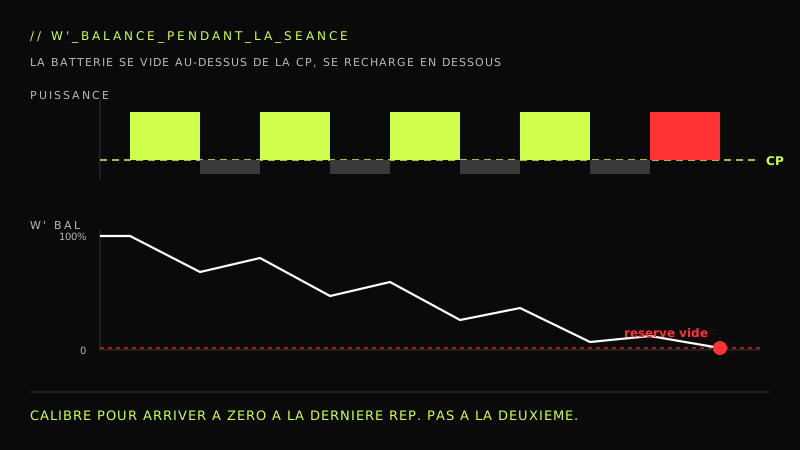
W’ balance models your reserve second by second. It drains above CP, it recharges below, but slower than it drains. A good interval session is a battery you bring close to zero on the last rep. Not the second.
Recoveries too short, the battery collapses and the session dies halfway. Too long, you recharge everything and lose the cumulative stimulus. The right dose gets calculated, not attempted.
The Cornerman verdict
You spend your life guessing your intervals. The right power, the right number of reps, the right recovery. You feel your way session after session, and you call it experience.
Two maximal efforts give you a line. That line gives you two numbers. Those two numbers give you an equation. And that equation tells you, to the watt and to the second, what your body can take.
Physiology did the work sixty years ago. Use it.