
Everyone sends you to Zone 2. Your plan, your podcast, the guy ahead of you at the club café.
The reason given is always the same: it builds mitochondria. Nobody has ever shown you the paper.
Here it is. It doesn’t say what you were told.
What you were sold
The story is neat and it stands up. At low intensity you burn mostly fat. Burning fat takes mitochondria. The body builds more to meet the demand, through a regulator called PGC-1α. Three easy hours on the bike, and you come home with a slightly bigger engine.
Every link in that chain is true. Training does build mitochondria, one of the best established facts in exercise physiology: the first demonstration dates back to 1939.
The problem sits elsewhere. The story implies low intensity does this better than everything else. That, nobody has ever shown.
Nobody agrees on what it is
Before asking what Zone 2 builds, you need to know what you are talking about. That’s where it gets messy.
In sports science, three papers carry “zone 2” in their title. Three. All three published in 2025. Half a century of endurance physiology behind us, and the term everyone uses only became an object of study last year.
The most telling of the three is literally called What Is “Zone 2 Training”?. Sitko and colleagues gathered fourteen sport scientists and professional coaches in the International Journal of Sports Physiology and Performance to try to reach a consensus on the definition. You don’t publish that paper when the definition is clear.
And when you measure, it scatters. Meixner and colleagues, the same year, put fifty cyclists through an incremental test and a step test. Then they compared the markers commonly used to bound Zone 2. The coefficients of variation run from 6 % to 29 % depending on the marker. The first ventilatory threshold and FatMax line up well. Fixed percentages of maximum heart rate go everywhere. Their conclusion is blunt: depending on the marker you pick, Zone 2 stands for physiological demands that have little to do with one another.
Storoschuk and colleagues give the most brutal illustration. In their lab, in a 20-year-old woman, the first lactate threshold lands at 23 % of peak power. In an 18-year-old woman, at 57 %. Two cases, not a population statistic. But prescribe “60 to 75 % of FTP” to those two and one rides far below her threshold while the other rides far above.
Your zones are built on a single number, and that number is already an approximation.
What the measurement actually says
Now the substance. In 2025 Mølmen, Almquist and Skattebo published a systematic review with meta-regression in Sports Medicine on mitochondrial and capillary growth in human skeletal muscle. It is the heaviest piece of work that exists on the question: 425 papers retained, and for the mitochondrial part, 353 studies and 5,650 participants across 506 training groups.
They compare three families: continuous endurance below threshold, intervals above threshold, and short sprints of 4 to 90 seconds. After adjusting for session frequency, protocol duration and starting level, here is the mitochondrial content gained.
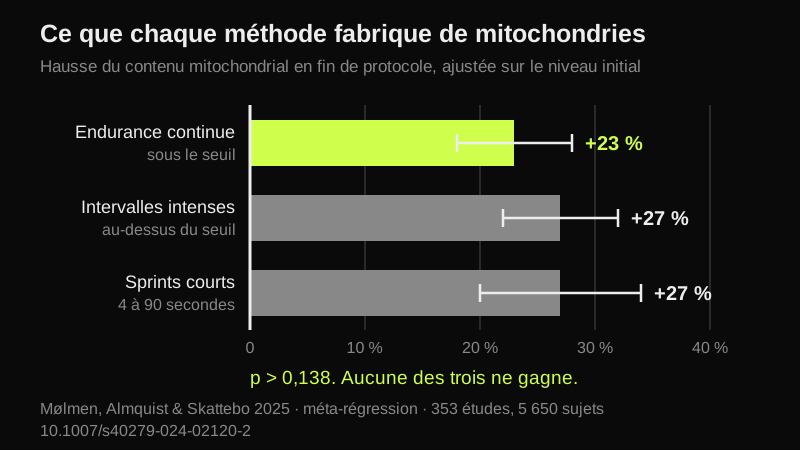
Twenty-three, twenty-seven, twenty-seven. p > 0.138. No difference. And the result doesn’t move with age, sex, menopause, disease, or how much muscle mass is involved.
The second number is the one that stings. Per hour of exercise, short sprints are about 2.3 times more efficient than intervals and 3.9 times more efficient than continuous endurance. Intervals are about 1.7 times more efficient than continuous endurance.
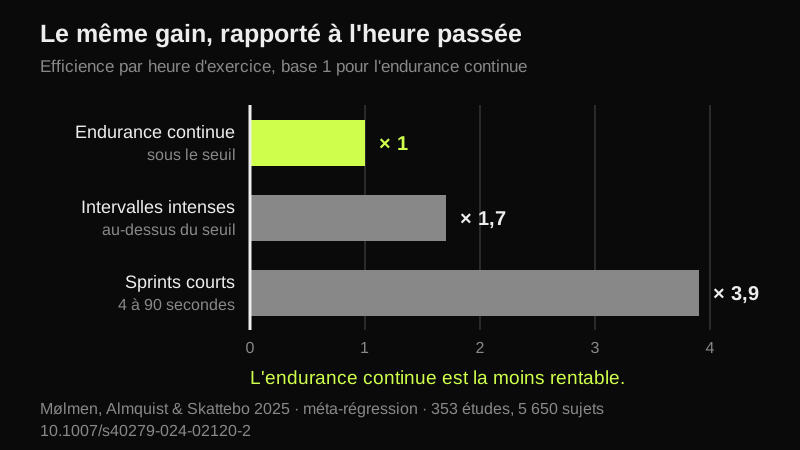
Your Zone 2 arrives at the same place as the others. It takes almost four times as long.
What the authors themselves take from it is not a ranking of methods. It’s that the good predictor is load, intensity multiplied by volume. They write it without hedging: high intensity compensates for low volume, and the reverse. These are not two camps. They are two currencies buying the same thing.
What still holds
Stop here and you’ll bin your Zone 2 and make a mistake. Three results from the same paper save it.
First, and this is the big one: intensity plateaus. The authors observe that short sprints stop raising mitochondrial content after the first two weeks. Their wording is clean: high intensity compensates for low volume in short protocols, but more volume is needed to keep mitochondrial content climbing over time. Intensity gives you a head start. Volume is the only thing that keeps the curve tilted.
Second: capillary density. Capillaries per fibre rise the same in all three families (+15 % continuous endurance, +13 % intervals, +10 % sprints, p = 0.556). But capillaries per square millimetre only rise with continuous endurance (+13 %) and intervals (+7 %), and continuous endurance beats the other two, this time significantly. The reason is mechanical: intensity grows the muscle fibre more, which dilutes the capillaries over a larger area. So there is one thing low intensity does better than the rest. It isn’t mitochondria.
Third: frequency. Six sessions a week beat four, which beat two, for mitochondria as for VO2max. And six sessions a week is not something you hold in sprints. Zone 2’s low fatigue cost isn’t a weak stimulus, it’s what makes the frequency possible.
What nobody has tested
Two limits, and they aim straight at the reader of this blog.
The capillary gains in this meta-regression happen mostly in the first four weeks, and they were only observed in untrained to moderately trained subjects. The lower the starting level, the bigger the percentage gain. Put another way, a good share of that trainability is a beginner’s. What it looks like in someone who has been riding for six years, the paper does not say.
And the only work that takes Zone 2 as a subject in its own right, the Storoschuk review, covers the general population. It says so in the title. It is not a systematic review and it is not a meta-analysis: it is a narrative review, with no pooled effect size. Nobody has measured mitochondrial content in trained cyclists after a Zone 2 dominant block against an intensity dominant block, at matched load. The paper that would settle this doesn’t exist.
The Cornerman verdict
Zone 2 is not a mitochondria factory. It’s an hours budget. What builds the engine is load, and load is paid in intensity or in time, your pick.
On low volume, time is your scarce resource and intensity buys the adaptation faster. Once the hours exist, Zone 2 takes back the majority, because it is the only currency you can spend six times a week without paying for it. That’s our call, not a study result, and we’d rather say so.
Stop riding easy for your mitochondria. Ride easy so you can ride tomorrow.
What we don’t know
There is no consensus definition of Zone 2: depending on the marker, coefficients of variation run from 6 % to 29 % in fifty cyclists measured in a lab, and a panel of fourteen experts had to publish a commentary in 2025 to try to sort it out.
No study has compared a Zone 2 dominant block to an intensity dominant block, at matched load, while measuring mitochondrial content in trained cyclists. The capillary gains in the meta-regression were only observed in untrained to moderately trained subjects, and mainly during the first four weeks. Carrying those numbers over to an already built athlete is a hypothesis, not a measurement.
Finally, mitochondrial content is a biological marker, not a stopwatch. It moves at a ratio of roughly 2 to 3 for 1 with VO2max, and the link between VO2max and your actual performance is a whole other argument.
Sources
- Mølmen KS, Almquist NW, Skattebo Ø (2025). Effects of Exercise Training on Mitochondrial and Capillary Growth in Human Skeletal Muscle: A Systematic Review and Meta-Regression · Sports Medicine ·
10.1007/s40279-024-02120-2· systematic review and meta-regression, 425 papers retained, 353 studies and 5,650 participants for the mitochondrial part. - Sitko S, Artetxe X, Bonnevie-Svendsen M et al. (2025). What Is “Zone 2 Training”?: Experts’ Viewpoint on Definition, Training Methods, and Expected Adaptations · International Journal of Sports Physiology and Performance ·
10.1123/ijspp.2024-0303· commentary from a panel of 14 experts. - Meixner B, Filipas L, Holmberg HC, Sperlich B (2025). Zone 2 Intensity: A Critical Comparison of Individual Variability in Different Submaximal Exercise Intensity Boundaries · Translational Sports Medicine ·
10.1155/tsm2/2008291· cross-sectional study, 50 cyclists (30 men, 20 women). - Storoschuk KL, Moran-MacDonald A, Gibala MJ, Gurd BJ (2025). Much Ado About Zone 2: A Narrative Review Assessing the Efficacy of Zone 2 Training for Improving Mitochondrial Capacity and Cardiorespiratory Fitness in the General Population · Sports Medicine ·
10.1007/s40279-025-02261-y· narrative review, general population. - Abrego-Guandique DM, Aguilera Rojas NM, Chiari A et al. (2025). The impact of exercise on mitochondrial biogenesis in skeletal muscle: A systematic review and meta-analysis of randomized trials · Biomolecular Concepts ·
10.1515/bmc-2025-0055· systematic review and meta-analysis of randomised trials; PGC-1α rises after endurance exercise, Hedges’ g 1.17 (95 % CI 0.14–2.19), with substantial heterogeneity (I² = 84.5 %).
How the count was done: we searched for the phrase “zone 2” in the titles and abstracts of the indexed sports science literature. Fifty-three papers mention it somewhere. Three carry it in their title, all published in 2025. That’s a density signal, not an exhaustive bibliography.