
You build your base on sweet spot. Or on 80/20. Depends which podcast you listened to last.
Both camps talk with exactly the same confidence. Their case files look nothing alike.
What you were sold
For twenty years the dominant model was threshold work. A lot of time spent between the two thresholds, where it hurts without blowing you up.
Then Seiler measured what endurance elites actually did, and the result went round the world: they spend the vast majority of their time very easy. The polarized model was born, and elite athletes and amateurs adopted it with the same fervour. The authors of the 2024 meta-analysis note it as a plain fact, almost annoyed.
In between, sweet spot settled into training plans everywhere. The clever compromise. Hard enough to build, sustainable enough to stack.
Three schools, three certainties. Open the files.
What the measurements actually say
The belief that polarized wins rests on one 2019 meta-analysis, Rosenblat and colleagues, in the Journal of Strength and Conditioning Research. It finds a moderate effect favouring polarized over threshold on time-trial performance, effect size −0.66.
Look at the detail. Four studies retained. Three in the meta-analysis itself. Rated 4 and 5 out of 10 on the PEDro scale. A decade of talk was built on that.
Three heavier pieces of work have landed since, and they tell a different story.
Silva Oliveira and colleagues, 2024 in Sports Medicine, pool 17 studies and 437 athletes. They confirm an advantage for polarized, but on VO2max only, and barely: effect size 0.24, with a confidence interval whose lower bound touches 0.01. A hair away from zero.
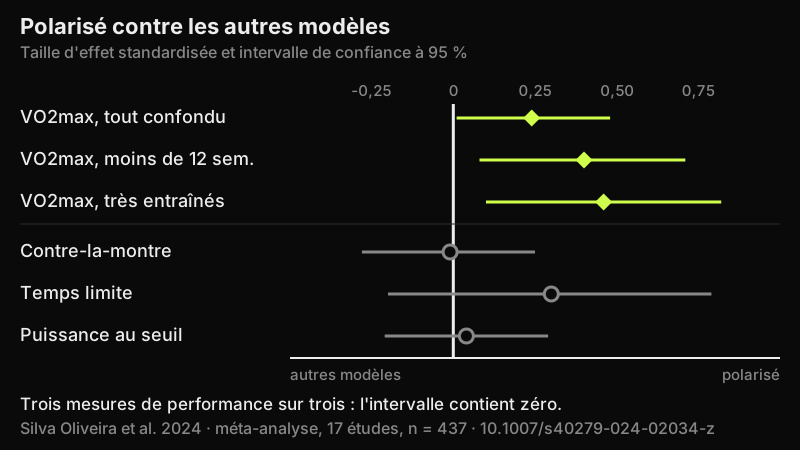
And that advantage evaporates the moment you look at what counts. On the time trial, the effect size drops to −0.01. On time to exhaustion, nothing. On threshold power, nothing.
The only measured gain from polarized is a lab number that does not turn into performance.
The same authors spell out when that advantage shows up: in protocols shorter than twelve weeks, and in highly trained athletes. Two conditions you probably don’t meet.
Then comes the strongest piece of the lot. Rosenblat again, 2025, an individual participant data network meta-analysis. That is the best design available for comparing several models against each other. Thirteen studies, 348 athletes, 150 of them recreational.
Verdict: no difference between polarized and pyramidal, not on VO2max, not on the time trial. No difference either between polarized and any other model.
One thing does come out, and it decides everything. The response depends on the athlete’s level, statistically and clearly. Competitive athletes improve more on polarized. Recreational athletes improve more on pyramidal.
Pyramidal is a lot of easy, a real share of middle work, and little very hard. Which is roughly what your sweet spot plan already does without saying so.
That leaves the cyclist. Cove and colleagues, 2025 in the Journal of Science and Medicine in Sport, looked at 41 studies, 81 training groups, 797 trained cyclists. Polarized against non-polarized: no significant difference. Everyone improves, at roughly the same rate.
They add a line few people want to hear. Past a necessary minimum volume, they find no association between weekly volume and the gains.
What still stands
Polarized is not an empty fashion, and that needs saying.
The trial that founded it exists, it is clean, and it is stubborn. Esteve-Lanao and colleagues, 2007, followed twelve sub-elite runners for five months. One group at 80.5 % easy volume, the other at 66.8 %, with exactly the same dose of hard work on both sides. Over a 10.4 km cross-country race, the first group gained 157 seconds, the second 121. The gap is significant.
Twelve runners. Five months. That is not many people, and they are not cyclists. But the principle it illustrates holds: the more genuinely easy your easy rides are, the harder your hard rides can be.
The real danger isn’t picking the wrong model. It’s applying none of them and spending your life in the grey zone, just above the aerobic threshold, too hard to recover from and too soft to overload. Coaching textbooks reckon self-coached athletes spend half their time there. That is an author’s position, not a measurement, and we hand it to you as such.
The count nobody ran
We searched sweet spot in the titles and abstracts of the sport science literature.
Seven hits. Zero in cycling.
The seven are about the strike zone of a tennis racket, the ideal delay before returning to sport after an ACL rupture, and the settings on an insulin pump.
For comparison, the same search on intensity distribution returns 115.
Be clear about what that means and what it doesn’t. Intensity exists, it is studied, and it works. It is simply studied under another name: threshold work. And threshold work is precisely the model the 2019 meta-analysis found inferior to polarized.
Sweet spot is a coach’s word. It has no literature. When someone sells it to you as scientifically superior, he is selling you a brand.
And a second thing is missing, more awkward still. None of these studies sorts its results by weekly training hours. The Galán-Rioja review on trained cyclists gives the range everyone in there is working in: between 7.5 and 11.68 hours a week. Its conclusion is a sentence few coaches quote: no evidence currently favours any particular periodisation model.
The house rule
The house rules on volume, and owns the fact that this is a translation.
The share of easy work rises with your hours. Under six hours a week, time is your scarce resource and intensity pays more per hour: sweet spot dominates. Past ten to twelve hours, Zone 2 takes back the majority and you aim at 80/20.
That switch is consistent with what you have just read, without being a copy of it. The papers split on the athlete’s level. We split on hours, because your hours are a number you know and your level is something you imagine. The two overlap heavily. They are not the same variable, and we would rather tell you.
The Cornerman verdict
The debate eating your time is smaller than you think. On real performance, no model beats another in the trained cyclist.
What decides it is that your easy rides are genuinely easy and your hard rides are genuinely hard. The rest is an argument about labels.
If you ride little, intensity pays you more per hour. If you ride a lot, easy takes the majority back. That is all the literature allows anyone to say, and it is already more than most plans explain to you.
What we don’t know
Nobody has compared sweet spot head to head with polarized, at equal volume, in the trained cyclist. That is the comparison that would settle the argument of the last ten years. It does not exist.
No study stratifies its results by weekly hours. The switch the house applies at six and at twelve hours is a piece of reasoning, not a measured result.
The recreational versus competitive subgroup comes from a secondary analysis. The primary analysis of that same meta-analysis finds no difference. A significant subgroup inside a globally null analysis is a signal, not proof.
The cyclists in the 2025 meta-analysis had a VO2max of at least 59 ml/kg/min at inclusion. These are already solid people. Nothing says a beginner responds the same way.
Sources
Silva Oliveira P, Boppre G, Fonseca H (2024). Comparison of Polarized Versus Other Types of Endurance Training Intensity Distribution on Athletes’ Endurance Performance: A Systematic Review with Meta-analysis. Sports Medicine · meta-analysis, 17 studies, n = 437 · 10.1007/s40279-024-02034-z
Rosenblat MA, Watt JA, Arnold JI, et al. (2025). Which Training Intensity Distribution Intervention will Produce the Greatest Improvements in Maximal Oxygen Uptake and Time-Trial Performance in Endurance Athletes? Sports Medicine · individual participant data network meta-analysis, 13 studies, n = 348 · 10.1007/s40279-024-02149-3
Cove B, Chalmers S, Nelson MJ, Anderson M, Bennett H (2025). The effect of training distribution, duration, and volume on VO2max and performance in trained cyclists. J Sci Med Sport · multilevel meta-analysis, 41 studies, n = 797 · 10.1016/j.jsams.2024.12.005
Rosenblat MA, Perrotta AS, Vicenzino B (2019). Polarized vs. Threshold Training Intensity Distribution on Endurance Sport Performance: A Systematic Review and Meta-Analysis of Randomized Controlled Trials. J Strength Cond Res 33(12):3491-3500 · meta-analysis, 3 studies · 10.1519/jsc.0000000000002618
Galán-Rioja MÁ, Gonzalez-Ravé JM, González-Mohíno F, Seiler S (2023). Training Periodization, Intensity Distribution, and Volume in Trained Cyclists: A Systematic Review. Int J Sports Physiol Perform · systematic review, 7 studies · 10.1123/ijspp.2022-0302
Esteve-Lanao J, Foster C, Seiler S, Lucia A (2007). Impact of training intensity distribution on performance in endurance athletes. J Strength Cond Res · randomised controlled trial, n = 12 · 10.1519/r-19725.1
How the count was done: a search for the phrases “sweet spot” and “training intensity distribution” in the titles and abstracts of the indexed sport science literature. Seven papers name sweet spot, none in cycling; intensity distribution returns one hundred and fifteen. It is a density signal, not an exhaustive bibliography.