
You finish your session. You don’t get off the bike. You spin the legs for ten more minutes, easy, because that’s what everyone does.
Nobody has ever asked you why.
What you were sold
Flush the toxins. Avoid the soreness. Prevent injuries. Bring the body down gently.
Four promises. Here is what survives once you measure them.
Seven markers tested, seven times nothing
In 2018, Van Hooren and Peake published the first serious review on the subject in Sports Medicine. Their opening remark says plenty on its own: this belief had never been reviewed before. Decades of repeating it, and nobody had gathered the data.
They compared an active cool-down against a passive one, meaning doing nothing at all, across seven recovery markers.
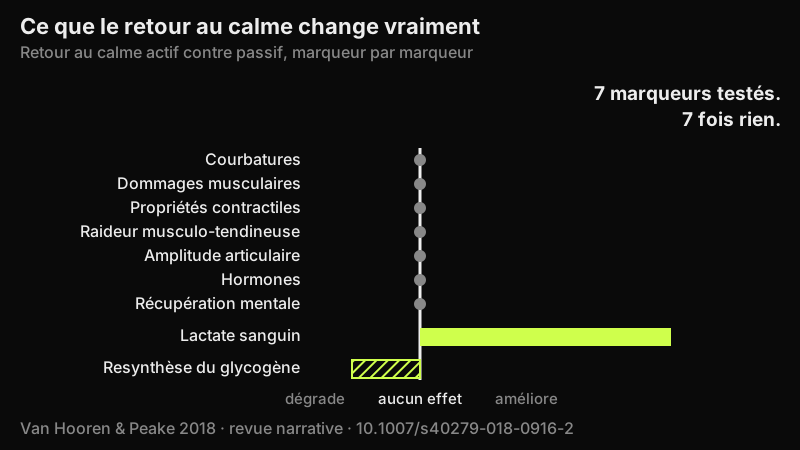
Seven results. Seven times nothing.
On injuries, the answer is older still. In 1993, a randomised controlled trial followed 421 runners for sixteen weeks. One group did warm-up, cool-down and stretching. The other did none of it. Result: 4.9 injuries per 1,000 hours in the control group, 5.5 in the group running the protocol. The intervention prevented nothing at all.
Where the myth comes from
Blood lactate does clear faster when you keep moving. That part is true, and it is measured.
The problem is the conclusion drawn from it. A number went down, so an athlete was recovering. Two mistakes in that sentence.
First, lactate drops in the blood, not in the muscle. Different place.
Second, blood lactate is a poor indicator of recovery. The systematic review by Ortiz and colleagues in 2019 (26 studies, 471 athletes) says so bluntly.
A universal ritual, built on a marker that never measured what everyone assumed it did.
The detail that stings, and its caveat
Van Hooren and Peake flag something else. An active cool-down can interfere with muscle glycogen resynthesis. You spend ten minutes delaying the one recovery process that is solidly established.
Read the next line, because it changes the practical conclusion. The studies that found this interference used cool-downs of 10, 15 and 45 minutes, and the authors state explicitly that the shorter the cool-down, the less it interferes.
So it isn’t an argument for scrapping it. It’s an argument for keeping it short.
What it does do
We’re not throwing the baby out to get a better headline.
An active cool-down might blunt the immune dip right after the effort, the open window when you catch things more easily. With two caveats the authors put down themselves: the effect is probably negligible beyond 2 hours after the session, and no study has checked that it translates into fewer illnesses.
It also speeds the return to baseline of the cardiovascular and respiratory systems. Again, nobody knows whether that lowers the risk of fainting or of a complication.
Two real effects, two shrugs about whether they matter. Honest to say so.
What nobody has ever tested
No study varies cool-down duration by session type.
Zero. Not one.
Nobody has compared what to do after a long ride against what to do after a VO2max session. The only range with a source behind it is 6 to 10 minutes, all sessions lumped together. It comes from Ortiz, who found consistent positive effects on performance in that window.
And if you want a referee to settle active against passive recovery, the most recent systematic review, Zouhal and colleagues in 2024, concludes the question stays open.
The Cornerman verdict
Six to ten minutes, after a hard session, and that’s it.
After an endurance ride it adds nothing. Your pace was already a cool-down.
And above all: it is not a recovery tool. It is a cardiovascular wind-down. That’s something. It isn’t what you were sold.
Here’s the trade-off that counts when you’re short on time. Ten minutes spinning the legs, or ten minutes of sleep or refuelling. Take the second one. No hesitation.
The ritual survived thirty years without anyone measuring it. Now it’s been measured.
What we don’t know
No study sets a duration per session type. The 6 to 10 minute range is a global marker, not a targeted prescription.
Van Hooren and Peake is a narrative review, not a meta-analysis. There is no pooled effect size behind these conclusions. The message isn’t that it has been proven useless, it’s that nothing has ever shown it works. The difference counts.
The immune and cardiorespiratory effects are tied to no clinical outcome. A marker gets measured. Whether it changes anything, nobody knows.
Active against passive stays an open question over long-term training (Zouhal 2024).
Sources
Van Hooren B, Peake JM (2018). Do We Need a Cool-Down After Exercise? A Narrative Review. Sports Medicine · 10.1007/s40279-018-0916-2
Ortiz RO, Sinclair Elder AJ, Elder CL, Dawes JJ (2019). A Systematic Review on the Effectiveness of Active Recovery Interventions on Athletic Performance. J Strength Cond Res 33(8):2275-2287 · 10.1519/jsc.0000000000002589
van Mechelen W, Hlobil H, Kemper HC, Voorn WJ, de Jongh HR (1993). Prevention of running injuries by warm-up, cool-down, and stretching exercises. Am J Sports Med · 10.1177/036354659302100513
Zouhal H, Abderrahman AB, Jayavel A, et al. (2024). Effects of Passive or Active Recovery Regimes Applied During Long-Term Interval Training. Sports Med Open · 10.1186/s40798-024-00673-0