

Ken has the smart trainer. The power meter. The twelve-week plan, in a folder, sessions numbered.
He rides once every two months.
Ken is not lazy. Ken is being logical. As long as no date is waiting for him, reading one more article costs nothing and improves the plan. Refining before launching is the rational choice. His premise is wrong, and that is the only thing wrong with him.
What you were sold
Open any serious training system. Friel, Daniels, Coggan. You will find the same architecture: start from the race date, then work backwards.
Base, build, specific, taper. Each block exists because another one follows it, and the last one exists because a number is pinned to your chest on a given morning.
Take the date away. Nothing is left.
That is not an exaggeration. Friel writes it himself: for a twelve-month horizon, his documented answer is to repeat base three as many times as needed. It is the most honest answer on the market, and it is a confession.
So Ken waits for a date. And the date never arrives, because nothing in this industry is built to hand him one.
What the measurement actually says
We searched the sport science literature for every study describing a training intervention with a stated duration in weeks.
3,961 studies. Median duration: 8 weeks. 83 % run twelve weeks or less. 0.4 % reach a year.
The undated plan has not been studied badly. It has never been studied at all. The canonical research protocol is test, block, test. An object with no end point does not fit that mould, so nobody put it there.
That is the hole. Now what fills it.
The absence of an architecture is not the absence of rules. There is a literature on maintenance. It is old, it carries numbers, and it answers a different question: what minimum dose protects what.
One laboratory ran three experiments, same protocol, twelve subjects, ten weeks of building followed by fifteen weeks at reduced load. One variable changed at a time.
Cut frequency, six days down to two: VO2max holds completely. Cut duration, forty minutes down to thirteen: VO2max still holds, long endurance loses 10 %.
Cut intensity by a third, and the whole thing collapses. VO2max is no longer maintained. Long endurance falls from 184 to 145 minutes, down 21 %. Left ventricular mass, which had gained 15 % through training, returns exactly to baseline. At a two-thirds cut, long endurance drops from 202 to 141 minutes.
This is a 1985 trial on twelve people. It is not a meta-analysis and I am not going to sell it to you as one. But it is the only design that isolates the three variables one by one, and its result has never been overturned.
Volume is highly compressible. Frequency, moderately. Intensity, not at all.
The price
Now the part that hurts, and it comes with numbers.
Every quality has a shelf life. How long it holds after you stop training it.
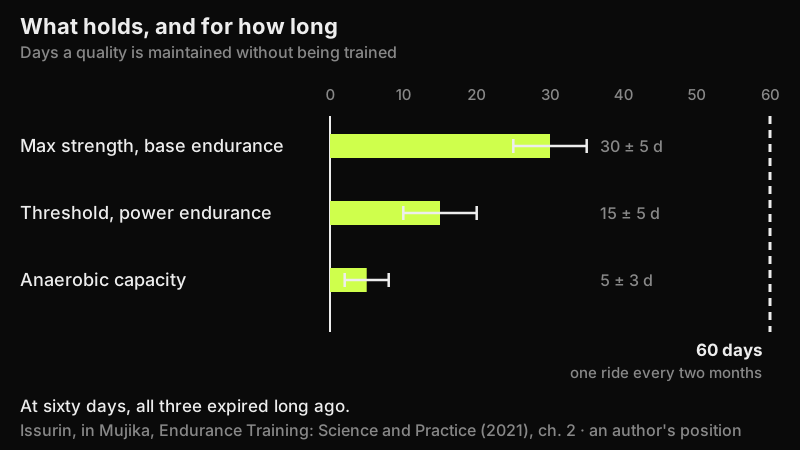
Thirty days for maximal strength and base endurance. Fifteen for threshold. Five for anaerobic.
Back to Ken. One ride every two months, so sixty days. Every time he gets on the bike, all three clocks rang a long time ago. He is not picking his training back up where he left it. He is starting from below it.
You have a folder of plans you never launched. So do I. Mine had a name ending in v3, which should be enough to describe the problem.
And here is the detail nobody gives you, because it cuts both ways. A 2022 meta-analysis looked at 21 studies on training cessation. The VO2max loss is clear in the short term and more severe in the long term. But between thirty to ninety days off and more than ninety days off, there is no significant difference.
The damage happens early, then it stops. Waiting another six months costs you roughly what the first two already cost you.
Translation: most of the price is already paid. What you can still save is tomorrow.
What those numbers do not say
The authors of the reference review on maintenance doses are explicit, and they deserve to be quoted honestly: their numbers come from general populations, not athletes. They write it in their own abstract. We apply them anyway, for want of better, and we say so.
The three experiments on intensity date from 1981, 1982 and 1985. Twelve subjects. That is small, that is old, and nobody has redone the work since.
As for the shelf lives, they are a practitioner’s figures, not a measurement. They carry no confidence interval because they were never measured as such.
What nobody has tested
The plan with no deadline has no validated model. None. What you just read is assembled from rules verified separately, and nobody has tested the assembly.
It gets worse. The literature on the training plateau does not exist either. The papers containing the word describe the VO2max plateau in an incremental test, or the tibial plateau. Zero studies on the athlete who stalls.
The only documented answer to stagnation is to raise the dose: non-response to training falls from 69 % to 0 % when you go from one to four sessions a week. An answer that is useless to anyone already at their hourly ceiling, which is nearly everyone.
The Cornerman verdict
You do not need a start date. You need to know what expires, and when.
A plan without a race is not base, build, specific. It is a grid of reminders: every quality you intend to keep gets touched at least once inside its window, at full intensity, with volume floating around your life. You develop one thing at a time. Everything else is simply not dying.
It is not elegant and it looks like no plan ever sold to you. It fits in one line: miss the volume, never the intensity.
Ken, if you are reading this. The date you are waiting for is not coming. The only clock running is the thirty-day one, and it started without asking you.
What we do not know
Training without a dated goal has never been studied. Our model is a composition of separately validated rules, not an experimental result. We present it as such.
The maintenance doses come from general populations. The authors themselves write that there is not enough data to make specific recommendations for athletes.
The shelf lives are an author’s position. Thirty, fifteen and five days are practitioner’s figures, with no confidence interval and no trial that measured them directly.
No literature on the training plateau. The only known answer, raise the dose, does not apply to anyone already at their hourly ceiling.
Sources
Hickson RC, Foster C, Pollock ML, Galassi TM, Rich S (1985). Reduced training intensities and loss of aerobic power, endurance, and cardiac growth. J Appl Physiol · controlled trial, n = 12 · 10.1152/jappl.1985.58.2.492
Hickson RC, Kanakis C, Davis JR, Moore AM, Rich S (1982). Reduced training duration effects on aerobic power, endurance, and cardiac growth. J Appl Physiol · 10.1152/jappl.1982.53.1.225
Hickson RC, Rosenkoetter MA (1981). Reduced training frequencies and maintenance of increased aerobic power. Med Sci Sports Exerc · 10.1249/00005768-198101000-00011
Spiering BA, Mujika I, Sharp MA, Foulis SA (2021). Maintaining Physical Performance: The Minimal Dose of Exercise Needed to Preserve Endurance and Strength Over Time. J Strength Cond Res 35(5):1449-1458 · narrative review · 10.1519/jsc.0000000000003964
Zheng J, Pan T, Jiang Y, Shen Y (2022). Effects of Short- and Long-Term Detraining on Maximal Oxygen Uptake in Athletes: A Systematic Review and Meta-Analysis. BioMed Res Int · meta-analysis, 21 studies retained from 3,315 · 10.1155/2022/2130993
Montero D, Lundby C (2017). Refuting the myth of non-response to exercise training. J Physiol · 10.1113/jp273480
Mujika I (ed.), Endurance Training: Science and Practice (2021), ch. 2, Issurin · the residual training effect durations. An author’s position, not a measurement.