

Jasper ordered the box. Thirty sachets, ninety euros, one hundred and twenty grams of carbohydrate per hour printed on the packaging as a selling point.
He has never gone past sixty grams on a ride.
On Sunday, halfway through a four-hour ride, he is going to find out what his gut thinks of that decision.
What you were sold
For twenty years the rule was simple and everywhere: sixty grams of carbohydrate per hour, physiological ceiling. Beyond that your body cannot keep up, you waste it, you make yourself ill.
Then the professional peloton started eating like never before. A hundred grams. A hundred and twenty. Whole teams doubling their intake, videos of riders draining a bottle of syrup an hour, and an industry following to the second.
And you watch that thinking your sixty-gram ceiling might be the thing holding you back.
Both numbers are wrong. Not in the same way.
What the measurement actually says
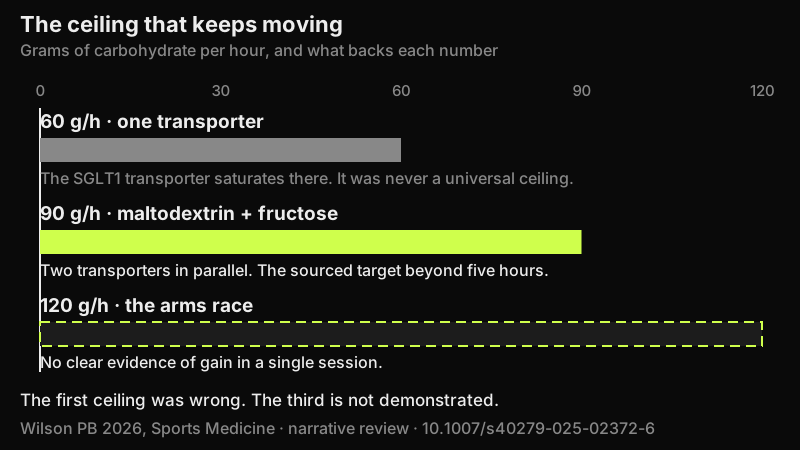
The sixty-gram ceiling was never a ceiling. It was the saturation point of a single intestinal transporter, SGLT1, the one that moves glucose. It was measured, it was published, and the world kept the number and forgot the condition.
Add fructose. It takes a different door, GLUT5. Both transporters work in parallel, and the ceiling rises. This has been measured since the mid-2000s, notably in Jentjens and Jeukendrup’s work on glucose-fructose blends, then in Wallis’s on maltodextrin.
The ceiling was not physiological. It was logistical.
So much for the first lie. Now the second.
A 2026 review in Sports Medicine revisited the high-carbohydrate revolution, the peloton one, from a hundred grams an hour upwards. Its verdict on the few studies that compared those intakes head to head with more traditional rates of sixty to ninety grams:
No clear evidence that it reduces reliance on stored glycogen, or that it improves performance.
Read it carefully. Not « it does not work ». No clear evidence. The distinction matters, and the author holds it himself.
The price
Now what it costs you, and nobody sells you that with the box.
A 2020 study put twenty elite runners through a mountain marathon with four thousand metres of cumulative climbing, in three groups: sixty, ninety, one hundred and twenty grams an hour. The 120 group finished with a markedly lower internal load, and twenty-four hours later, lower muscle damage markers on all three measured.
It works. Except there is one line in the protocol that nobody quotes:
The runners had previously undertaken nutritional and gut training.
The result only exists in people who had already done the work. Jasper bought the result without doing the work.
Gut training is the price. Weeks of long rides deliberately eating more than is comfortable, stepping up in stages, with the exact products you will use on race day. The gut adapts, it builds more transporters, it tolerates osmolarity better. It trains like a muscle and it takes just as long.
And this is not a guess. A 2010 study followed sixteen trained cyclists and triathletes for twenty-eight days. The group training with carbohydrate available every day raised its exogenous carbohydrate oxidation from 54.6 to 63.6 grams. The energy-matched control group did not move.
Your gut learns. It does not learn by reading the packaging.
Here is the honest trade-off: between buying 120-gram gels and doing six long rides at eighty, you take the six rides. Without hesitating. The second option is free and it is the only one that has produced a measured result.
What holds up anyway
The peloton is not mad, and the 2026 review says so too.
The studies that found nothing did not reproduce what a professional’s life actually is: days stacked on days. In a stage race, intake during the effort is strongly associated with total daily intake. Eating enormously on the bike may above all be a way of being able to start again tomorrow, through glycogen resynthesis and through an energy availability that does not collapse.
It is plausible, it is coherent, and it is not demonstrated. The author writes himself that these benefits rest on observational data and indirect arguments.
If you are doing a three-day raid or a training camp week, that logic concerns you. If you do one long ride on Sunday and work on Monday, it does not.
What nobody measured
And now we need to talk about who was measured.
In 2023, a standardised audit reviewed the literature underpinning current guidelines for carbohydrate intake around exercise. Nine hundred and thirty-seven studies. Eleven thousand two hundred and two participants.
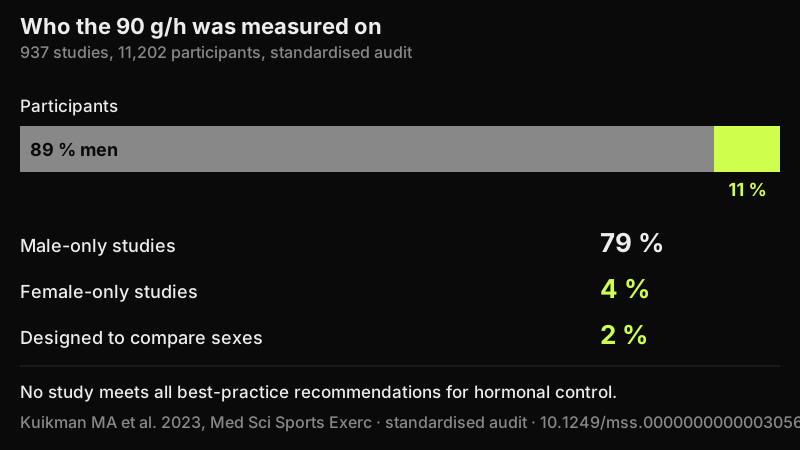
Eleven per cent women. Seventy-nine per cent of the studies are male-only. Four per cent female-only. Two per cent are designed to compare the two.
And among the studies that do include women, only seven per cent properly document control of ovarian hormones. None meets the full set of best-practice recommendations.
The number everyone repeats as a law of physiology was measured on a population nine-tenths male. That does not make it wrong. It means that if you are a woman, nobody has ever measured you, and the guideline you are handed is an extrapolation presented to you as a fact.
The Cornerman verdict
Three things, and they fit in three lines.
Sixty grams is not your ceiling. It was a transporter’s, not yours. Mix maltodextrin and fructose, add salt, and the door opens.
Ninety grams is the target once you go past five hours. That is the sourced number, that is the house number, and it covers roughly everything you do.
A hundred and twenty grams is not a target, it is a consequence. If one day you are stacking race days and your gut is trained for it, it will come on its own. Aiming for it before doing the work is buying the medal before the race.
Jasper is going to learn all of this on Sunday, in forty minutes and a single lesson. You just read it in five.
What we do not know
High intakes beyond a hundred grams an hour have no demonstrated benefit in a single session. The small number of studies comparing them with sixty or ninety grams show no clear gain, neither in glycogen sparing nor in performance.
The plausible benefit in stage races has not been tested. It rests on observational data and on a resynthesis argument, not on a trial that reproduced three weeks of racing.
The carbohydrate literature is nine-tenths male. No study directly measures peak exogenous carbohydrate oxidation in female athletes at different doses.
The 2026 review is a narrative review, not a meta-analysis. There is no pooled effect size behind its conclusions, and its author presents it as such.
Sources
Wilson PB (2026). A Narrative Review of the High-Carbohydrate Fueling Revolution (≥ 100 g/h) in the Professional Peloton. Sports Medicine · narrative review · 10.1007/s40279-025-02372-6
Kuikman MA, Smith ES, McKay AKA, Ackerman KE, Harris R, et al. (2023). Fueling the Female Athlete: Auditing Her Representation in Studies of Acute Carbohydrate Intake for Exercise. Med Sci Sports Exerc · standardised audit, 937 studies, 11,202 participants · 10.1249/mss.0000000000003056
Cox GR, Clark SA, Cox AJ, Halson SL, Hargreaves M, et al. (2010). Daily training with high carbohydrate availability increases exogenous carbohydrate oxidation during endurance cycling. J Appl Physiol · controlled trial, n = 16, 28 days · 10.1152/japplphysiol.00950.2009
Viribay A, Arribalzaga S, Mielgo-Ayuso J, Castañeda-Babarro A, Seco-Calvo J, Urdampilleta A (2020). Effects of 120 g/h of Carbohydrates Intake during a Mountain Marathon on Exercise-Induced Muscle Damage in Elite Runners. Nutrients · randomised trial, n = 20 · 10.3390/nu12051367
Jentjens RL, Jeukendrup AE (2005). High rates of exogenous carbohydrate oxidation from a mixture of glucose and fructose ingested during prolonged cycling exercise. Br J Nutr · 10.1079/bjn20041368
Wallis GA, Rowlands DS, Shaw C, Jentjens RL, Jeukendrup AE (2005). Oxidation of combined ingestion of maltodextrins and fructose during exercise. Med Sci Sports Exerc · 10.1249/01.mss.0000155399.23358.82