
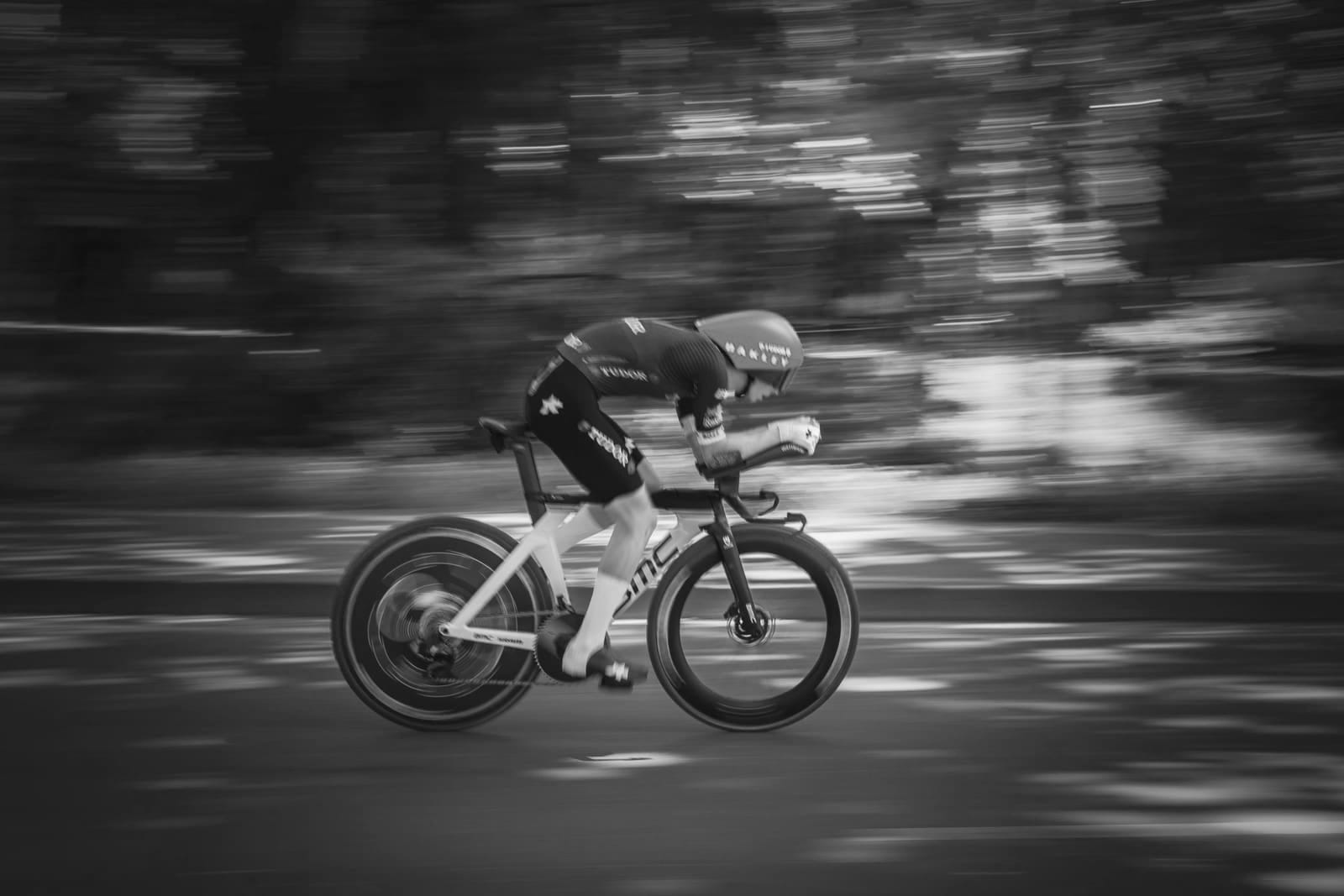
You come out of the water. Adrenaline is maxed out, your legs are fresh because they’ve done nothing for an hour, and dozens of guys are going past you.
You push. A bit harder than planned. You feel good, genuinely good, so you decide it’s a good day.
Athletes set personal bests over the first 40 kilometres of an Ironman. There are 140 left. Then a marathon.
They’ll walk.
The crime happens at the start, the sentence lands at the finish
It’s the cruellest statistic in long course: the number one cause of failed Ironmans isn’t a hole in the training, or nutrition, or the weather. It’s pacing in the first quarter of the bike.
And the culprit isn’t your engine. It’s your emotional system. You’re rested, wired, surrounded, and the only feedback your body sends you at that moment is a lie: everything is fine.
Everything is fine. For two hours. The problem with an Ironman is that it lasts nine or eleven.
What you pay for pushing too early
Every watt above your target isn’t borrowed from your bike. It’s borrowed from your marathon.
You empty your glycogen faster, you produce lactate you’ll have to clear, you stack muscle damage into quads that still have 42 kilometres of impact to absorb. None of it shows at the time. All of it shows at kilometre 25 of the run, when your legs simply stop obeying.
The bike isn’t won. It’s survived. The marathon decides the standings, and the marathon is decided coming out of T1.
Your numbers, not the numbers of the guy ahead
Without a power meter you ride on feel, and we just saw that feel lies precisely when it matters. With a meter, you have an objective handrail.
Target Ironman intensity sits around 68 to 78 % of your FTP, which puts your intensity factor at 0.70 to 0.76. On a half you go to 80-85 %. On an Olympic, you ride close to threshold.
Those numbers look low. They are. That’s exactly why most people ignore them, and exactly why most people walk the marathon.
There’s a simple way to calculate your target power instead of guessing it. You start from the total cost you can afford on the bike, roughly 280 load points for an age-grouper, and spread it over your estimated duration. For six hours of riding, that gives you around 47 points per hour, an intensity factor near 0.68. On an FTP of 275 watts, your target normalised power lands around 187 watts.
One hundred and eighty-seven watts. On a bike where you throw down 250 in training without thinking about it. That’s the level of restraint we’re talking about.
The number that exposes your pacing: VI
Your average power says nothing. Two athletes can finish the bike at 190 watts average: one rode smooth, the other yo-yoed. The second one arrives destroyed.
The variability index measures that. You divide your normalised power by your average power. The closer the result gets to 1.00, the steadier your effort was.
In long course you want a VI at or below 1.05. Above that, every spike you produced is a burnt match, and you only get one box.
In practice that means: you don’t surge out of every corner, you don’t answer when someone passes you, you don’t sprint the false flats. On a climb longer than three minutes you go to 105 % of target, no more. On a short rise of thirty seconds to two minutes you allow yourself 110 %, where in training you’d hit 140 %. And you back off immediately.
The negative split, and why it hurts the ego
The strategy that works is counter-intuitive: you ride the second half of the bike slightly harder than the first.
That means getting passed for two hours by people you’ll catch later, or find walking at the kilometre 30 aid station. Psychologically, it’s the hardest exercise of the day.
It isn’t an instinct you find on race day. It’s rehearsed in training, at least once a week over the last twelve weeks. You go out, you force yourself to ride the first hour under target, and you finish stronger. You teach your brain that feeling good early authorises nothing.
Write your pacing plan in watts, on paper, before the race. The first quarter is rigid, non-negotiable, written in advance. You make no emotional decisions for the first 45 kilometres.
Heat changes everything, T2 most of all
If the day is hot, your numbers drop. All of them.
A rise of about one degree in core temperature is enough to trigger early fatigue, and over two hours dehydration can cost you up to 8 % of cardiac output. Your target watts become fantasy watts.
The most dangerous moment is coming out of T2. You get off the bike, the wind cooling you disappears in one go, and your core temperature climbs while you start running. That’s where people fall apart, not at kilometre 35.
On the bike in the heat: you slow down on purpose, you pour cold water on your skin instead of drinking all of it, and you accept losing time on the bike to gain far more on the run.
What your gut is allowed to take
Second cause of DNF behind pacing: gut trouble. And the two are linked.
The harder you push, the more blood leaves your gut for your muscles, and the less you digest. Aggressive pacing doesn’t just kill your legs, it shuts your stomach. You can’t feed any more, so you run dry, so you slow down further.
Your intake is prepared months out, not the night before. The gut trains like a muscle: you build progressively from 40 to 60 then 80 grams of carbs per hour on your long rides, with exactly the race products. Nothing new on race day, not a gel, not a brand, not a concentration.
If you want to understand why a gel turns your stomach when you take it without water, it’s laid out in detail in the article on osmolarity.
The Cornerman verdict
Your Ironman isn’t decided in the last six kilometres of the marathon, when you’re digging into the mental reserve and it makes for good photos.
It’s decided in the first 45 kilometres of the bike, when you feel invincible and you have to decide, coldly, not to be.
Race-day performance is already written by your last six weeks of training. There’s no magic available on the start line. There’s only one thing left you can still ruin: pacing.
So you write your watts on a strip of tape, you stick it on your frame, and you respect them when your whole body is screaming that you could do better.