

You do your 20-minute test. You take 95 % of the average. You get a number. 250 W.
You stick that number everywhere: your zones, your sessions, your fitness curve. Your whole training life orbits around it.
That number is an average of two things it cannot tell apart. And that inability costs you precision in every single session.
What FTP claims to be
FTP is the power you are supposedly able to hold for an hour. Except you never do an hour-long effort to measure it. You do 20 minutes, multiply by 0.95, and call it your threshold.
It is a convention. Andy Coggan proposed it because it is simple to communicate and close enough to be useful. It democratised power-based training, and it deserves respect for that.
But a convention is not a physiological truth. And the research eventually said so plainly: FTP is not a valid marker of the highest steady metabolic state you can hold (Wong et al., 2022). What it measures and what it claims to measure are not the same thing.
You don’t have one engine, you have two
Here is what FTP cannot see.
When you ride, two systems are working. An aerobic ceiling, sustainable, fed by oxygen. And an anaerobic reserve, finite, that you burn when you go hard and short.
Exercise physiology has a clean model for this, and it dates back to 1965 (Monod and Scherrer). It describes the relationship between your power and how long you can hold it. Two parameters, not one.
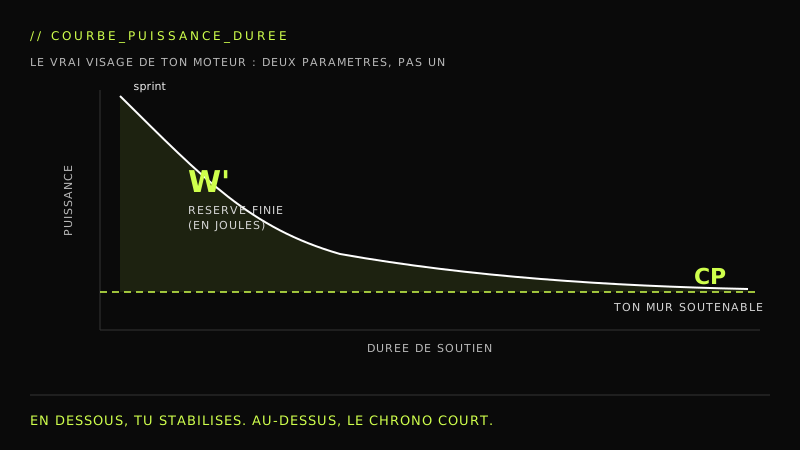
Critical Power (CP) is the asymptote of that curve. Your real sustainable wall. Below it, your body settles into the effort. Above it, fatigue becomes inevitable and your time to exhaustion is finite, and calculable.
W’ (say “W prime”) is the reserve of work you can produce above CP before you blow up. A battery, measured in joules. It drains when you exceed CP, it recharges when you drop back below. For an amateur, count 10,000 to 20,000 joules. A puncheur, far more. A diesel climber, far less.
Two riders with the same CP but a different W’ are opposite animals. One holds a climb at a steady pace and never cracks. The other puts 200 metres into you in a sprint, then dies over distance. Their FTP can be identical. On the road, they have nothing in common.
Why your 20-minute test lies to you
Take the puncheur again, the one with the big W’.
Across his 20-minute test, he isn’t only drawing on his aerobic ceiling. He is also emptying a good chunk of his anaerobic reserve. The result: his average is inflated by W’ he could never sustain for an hour. His “FTP” is overestimated.
That is exactly why some coaches subtract 7 % instead of 5 % for explosive profiles. It isn’t a wizard’s trick. It’s an empirical bandage over a flaw in the measurement. The power-duration model separates the two components cleanly, so the problem disappears at the root.
The literature agrees: FTP and CP are correlated, but not interchangeable (Karsten et al., 2020). The gap between them depends on your W’, so on your profile. For the diesel, they sit close together. For the puncheur, they diverge sharply.
Don’t go selling this model as a religion
CP is a better tool than FTP. That doesn’t make it absolute truth, and letting you believe otherwise would be exactly the kind of bullshit we take apart here.
Three honest limits.
CP is not holdable indefinitely. It’s a boundary, not a duration. Nobody holds their CP forever, in practice 30 to 60 minutes.
W’ is not fixed. It drops when you are tired, glycogen-depleted, or riding in the heat.
And the one that matters most if you race long: CP and W’ both degrade over a long ride. That’s durability. Your CP measured fresh overestimates what you can do in hour four. A model calibrated at rest lies about an Ironman.
The bonus nobody tells you about
This model isn’t only about cycling.
In running, the same equation exists under the name Critical Speed. In swimming, your 400-metre plus 200-metre test, the one that gives you your CSS, is already a two-point critical power model without you knowing it.
One framework, three sports. For a triathlete, that’s the foundation that ties everything together, where a metric like mechanical work in kilojoules only exists on the bike and dies the moment you put a foot on the ground.
The Cornerman verdict
Your FTP isn’t useless. It’s convenient for talking, everyone understands it, keep it for that.
But stop believing a single number captures your engine. There are two: a ceiling and a reserve. FTP crushes one into the other and leaves you guessing the rest.
Critical power separates them. And once they’re separated, you can do something FTP will never allow: calculate, to the watt, how long you’re going to last.